


Open Positions
3 year PhD position available (application deadline: 30 January 2026) within the project „FormiDablE - Function, Diversity and Evolution of formicine ant venom peptides” starting on the 01.06.2026 (or as soon as possible before or after)

(A) C. nicobarensis worker during acidopore grooming. (B) Venom gland of a C. nicobarensis worker (C) Total ion current (TIC) HPLC chromatogram of C. nicobarensis venom. Major peaks corresponding to peptides are labelled as formicitoxins (FRTX).
Project description
Venomous animals and the venoms they wield are a remarkable example of repeated evolution. In preliminary work, we have discovered so far unknown venom peptides in the highly acidic, formic acid containing venoms of non-stinging ants of the subfamily Formicidae (genus Camponotus). Aim of this project is to assess the diversity of these peptides in additional Formica and Lasius ant species, to manually annotate these peptides in genomes, to investigate the evolution of these peptides, and to investigate their potential biological function. To achieve this aim, in this interdisciplinary project within the Priority Program “GEvol: Genomic Basis of Evolutionary Innovations ”, we combine organismic (Simon Tragust,), comparative genomic and transcriptomic (Barbara Feldmeyer ) as well as analytical chemistry (Timo Niedermeyer ) know-how and methods.
We require
We are seeking a highly motivated candidate with an inquisitive, solution-oriented and frustration-tolerant mind that has excellent organisational skills to independently plan and conduct as well as analyse chemical, genomic and transcriptomic work. The following qualifications are required:
- Applicants must hold a Scientific University degree (MSc/Diploma) in biology, biochemistry or related fields
- Prior knowledge and/or experience with techniques and analyses involved in either proteomics, transcriptomics and/or genomics of insects (DNA/RNA extraction and analysis, next-generation sequencing, bioinformatics, HPLC)
- Driver’s license and/or experience with insect maintenance and dissection is a plus
- Fluency in English (lab working language) with good communication and social skills
We offer
- A friendly and inspiring working atmosphere in a young research group (for more information check out: https://www.zoologie.uni-halle.de/allgemeine_zoologie/staff/tragust/). The prospective PhD will be hosted in the lab of Simon Tragust (Halle) and will work in close collaboration with Barbara Feldmeyer (Frankfurt, https://www.senckenberg.de/en/research/institutes-overview/sbikf-institut/sbikf-ag-molecular-ecology/ ) and Timo Niedermeyer (Berlin, https://www.bcp.fu-berlin.de/pharmazie/faecher/pharmazeutische_biologie/team/professoren/niedermeyer/index.html )
- The group is embedded in the Department General Zoology sporting excellent, state of the art research facilities in the delightful, historic city of Halle with good and affordable living conditions and good connections to e.g. Berlin (~1h by train), Leipzig-Halle airport (~15min by train) or Frankfurt (~3h by train)
- A project that will help to develop and foster the applicant’s academic profile combining diverse techniques in an interdisciplinary project.
Application
Please submit your full application in English with registration number Reg.-Nr. 5-13320/25-D until 30th of January 2026 via e-mail as a single PDF to simon.tragust@zoologie.uni-halle.de. For informal queries about the position or the project please contact Dr. Simon Tragust (simon.tragust@zoologie.uni-halle.de). Applications should include a cover letter detailing the motivation of the applicant to join the project against the background of their research interests and experience, a CV, certificates (MSc/Diploma) and the names and email addresses of two potential referees. Interviews of applicants will take place in February/March.
Previous Positions
3 year PhD position available (application deadline: 15 March 2023) within the project „EMINENT: Consequences of an EMerging parasite on an INvasivE aNT in Europe” starting on the 01.08.2023 (flexible:
01.07.2023-01.10.2023)
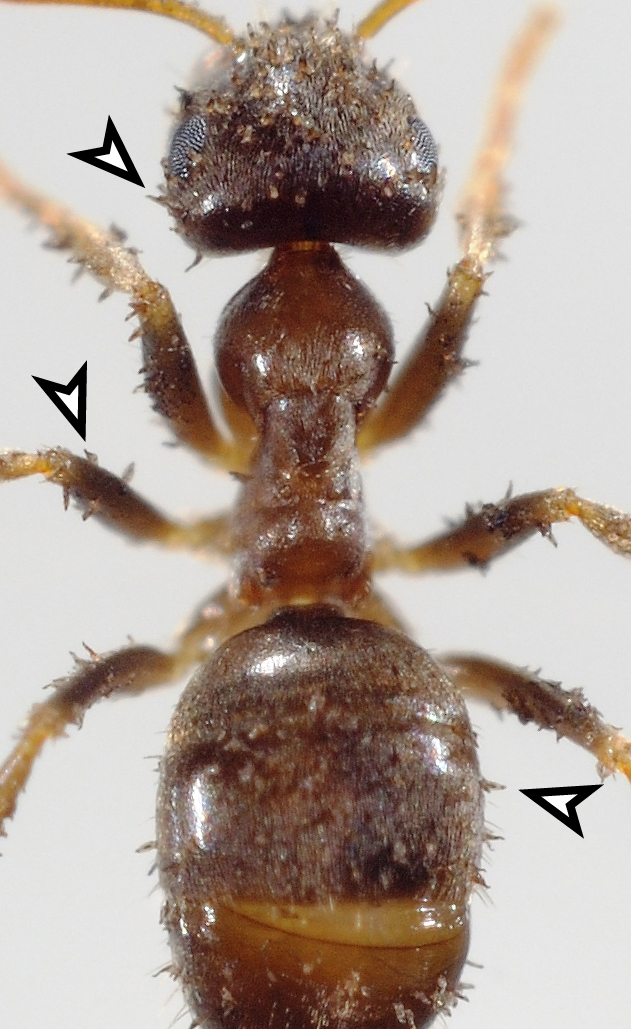
The invasive garden ant Lasius neglectus infected with the ectoparasitic fungus Laboulbenia formicarum (arrows)
Project description
Biological invasions and emerging infectious diseases are widely recognized as two of the most significant biological threats to biodiversity. In Europe a novel disease, the likely invasive ectoparasitic fungus Laboulbenia formicarum, has recently emerged on the invasive garden ant Lasius neglectus. Aim of the project is to assess the impact of Lab. formicarum emergence for the success of the invasive garden ant and the well-being of European native ants using a combination of field monitoring with sampling (mainly in Lyon, France, for 3-6 months), laboratory experiments (host reproduction, survival, and disease transmission) as well as molecular work (population genomics via PoolSeq whole genome sequencing).
We require:
We are seeking a highly motivated candidate with an inquisitive, solution-oriented and frustration-tolerant mind that has excellent organisational skills to independently plan and conduct laboratory and field work. The following qualifications are required:
- Applicants must hold a scientific University degree (MSc/Diploma) in biology or related fields
- Previous experience in field work, experiments involving insects and/or molecular techniques (DNA extraction, next generation sequencing, bioinformatics) is desirable
- Fluency in English (lab working language) with good communication and social skills
- French knowledge is a plus
- Driver’s licence valid in France is mandatory and (ideally) access to a car for field work
We offer:
- A friendly and inspiring working atmosphere in a young research group (for more information check out: https://www.zoologie.uni-halle.de/allgemeine_zoologie/staff/tragust/) with collaborative connections at the national e.g. the Freie Universität Berlin (Berlin) or the Centre for Integrative Biodiversity Research, iDiv (Leipzig) and international level (for field work in Lyon the applicant will work closely together with Dr. Bernard Kaufmann, Université Claude Bernhard Lyon 1: https://umr5023.univ-lyon1.fr/annuaire/details/1/41-kaufmann-bernard )
- The group is embedded in the Department General Zoology sporting excellent, state of the art research facilities in the delightful, historic city of Halle with good and affordable living conditions and good connections to e.g Berlin (~1h by train), Leipzig-Halle airport (~15min by train) or Munich (~3h by train)
- A project that will help to develop and foster the applicant’s academic profile combining diverse techniques in field, lab and molecular work.
Application:
Please submit your full application in English with registration number Reg.-Nr. 5-1086/23-D until 15th of March 2023 via e-mail as a single PDF to simon.tragust@zoologie.uni-halle.de. For informal queries about the position or the project please contact Dr. Simon Tragust (simon.tragust@zoologie.uni-halle.de). Applications should include a cover letter detailing their motivation to join the project and the group against the background of their research interests and experience, a CV, certificates (MSc/Diploma) and the names and email addresses of two potential referees. Interviews of applicants will take place until mid April.